
Global Electric Vehicle Market Overview
The global electric vehicle market is experiencing rapid expansion as governments, automotive manufacturers, and consumers increasingly prioritize sustainable and energy-efficient transportation solutions. Electric vehicles (EVs), powered by electric motors instead of traditional internal combustion engines, significantly reduce greenhouse gas emissions and lower dependence on fossil fuels.
The transition toward electric mobility is being accelerated by supportive government regulations, environmental policies, and technological innovations in battery systems. Countries worldwide are introducing stricter emission standards while investing heavily in clean mobility infrastructure, which is driving the adoption of electric vehicles across both developed and emerging economies.

Download a Free Sample Report with Full Table of Contents
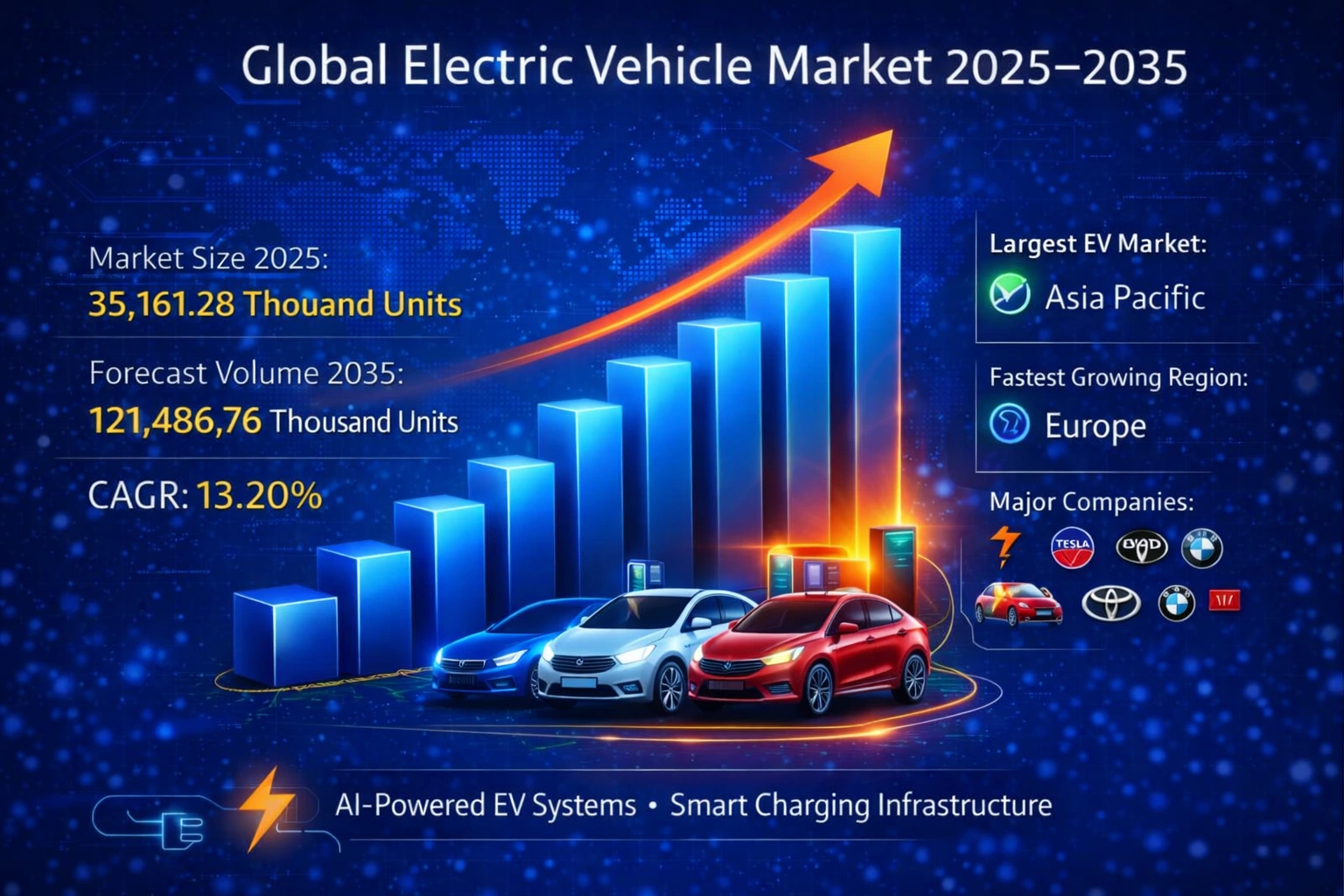
The global electric vehicle market reached a volume of 35,161.28 thousand units in 2025. With continuous investments in EV charging infrastructure, battery technology, and intelligent mobility systems, the market is projected to grow at a compound annual growth rate (CAGR) of 13.20% between 2026 and 2035, reaching nearly 121,486.76 thousand units by 2035.
Technological innovations in lithium-ion batteries, solid-state batteries, and advanced battery management systems (BMS) are improving vehicle performance, driving range, and charging efficiency. Additionally, the integration of artificial intelligence (AI) technologies and fintech-enabled charging payment systems is transforming the electric mobility ecosystem and enabling smarter, connected transportation solutions.
Electric Vehicle Market Key Insights
| Market Metric | Value |
|---|---|
| Market Size (2025) | 35,161.28 Thousand Units |
| Forecast Market Size (2035) | 121,486.76 Thousand Units |
| Market Growth Rate | CAGR of 13.20% |
| Largest Market Region | Asia Pacific |
| Fastest Growing Region | Europe |
| Key Technologies | AI-powered EV systems, Smart Charging Infrastructure |
| Major Companies | Tesla, BYD, Volkswagen, Toyota, BMW |
These insights demonstrate the strong momentum of the EV industry, driven by increasing demand for zero-emission vehicles, rapid battery technology development, and expanding global EV charging networks.
Global Electric Vehicle Market Size and Forecast
Over the past decade, the global electric vehicle industry has experienced significant growth due to rising environmental awareness and technological innovation. Governments and automotive manufacturers are increasingly focusing on reducing carbon emissions by transitioning toward sustainable transportation solutions.
In 2025, the electric vehicle market reached 35,161.28 thousand units, reflecting strong demand for battery electric vehicles and hybrid electric vehicles across major markets including China, the United States, and Europe.
During the forecast period from 2026 to 2035, the EV market is expected to expand significantly, reaching 121,486.76 thousand units. This growth will be supported by increased investments in EV manufacturing facilities, battery supply chains, and smart charging infrastructure.
Advancements in AI-driven vehicle systems and digital mobility platforms are also contributing to the rapid growth of the electric mobility ecosystem.
Key Drivers of Electric Vehicle Market Growth
Government Incentives and Environmental Policies
Governments worldwide are introducing financial incentives and regulatory policies to promote electric vehicle adoption. These include tax credits, subsidies, and investments in EV charging infrastructure.
Several countries have also announced long-term plans to phase out internal combustion engine vehicles in favor of zero-emission transportation systems. These initiatives are accelerating the global shift toward sustainable mobility solutions and helping achieve carbon neutrality goals.
Advancements in EV Battery Technology
Continuous improvements in EV battery technology are making electric vehicles more efficient and affordable. Innovations in lithium-ion batteries and emerging solid-state battery technologies are increasing battery energy density while reducing charging times.
Advanced battery management systems powered by artificial intelligence enable real-time monitoring of battery performance, improving efficiency and extending battery lifespan.
Expansion of EV Charging Infrastructure
The rapid expansion of global EV charging infrastructure is a major factor supporting electric vehicle adoption. Governments and private companies are investing heavily in public charging networks and ultra-fast charging stations.
Smart charging technologies integrated with fintech-based payment systems allow users to pay for charging services through mobile apps, digital wallets, and connected vehicle platforms, enhancing the convenience of EV ownership.
Emerging Trends in the Electric Vehicle Market
Rising Demand for Battery Electric Vehicles
Battery electric vehicles (BEVs) represent the fastest-growing segment of the EV market. These vehicles operate entirely on electricity and produce zero tailpipe emissions, making them a critical part of global decarbonization strategies.
Declining battery costs and technological improvements are making BEVs more accessible to consumers worldwide.
AI-Powered Electric Mobility
Artificial intelligence is transforming the electric vehicle industry by enabling intelligent vehicle systems and predictive analytics. AI-powered EVs can analyze driving patterns, optimize energy consumption, and monitor battery performance in real time.
AI-driven mobility platforms are also supporting the development of autonomous driving technologies and predictive maintenance solutions for EV fleets.
Electrification of Commercial Transportation
Commercial transportation is increasingly transitioning toward electric mobility. Logistics companies and ride-sharing platforms are adopting electric delivery vans, electric trucks, and electric buses to reduce fuel costs and carbon emissions.
AI-based fleet management systems help optimize routes, reduce energy consumption, and improve operational efficiency for electric commercial vehicles.
Electric Vehicle Market Segmentation
The global electric vehicle market can be segmented based on vehicle type and powertrain technology.
Market Breakup by Type
Battery Electric Vehicles (BEV)
Battery electric vehicles run entirely on electric power using rechargeable battery packs and produce zero emissions.
Hybrid Electric Vehicles (HEV)
Hybrid vehicles combine an internal combustion engine with an electric motor to improve fuel efficiency.
Plug-in Hybrid Electric Vehicles (PHEV)
These vehicles use rechargeable batteries and gasoline engines, enabling electric-only driving for shorter distances.
Market Breakup by Vehicle Type
Passenger Cars
Electric passenger vehicles dominate the EV market due to growing consumer demand and increasing EV model launches.
Electric Two-Wheelers
Electric scooters and motorcycles are gaining popularity in urban regions due to lower costs and environmental benefits.
Light and Medium Commercial Vehicles
Electric delivery vans are widely used for last-mile logistics services.
Light and Medium Commercial Vehicles
Electric buses and trucks are increasingly adopted in public transportation and freight logistics sectors.
Regional Analysis of the Electric Vehicle Market
Asia Pacific
Asia Pacific dominates the global electric vehicle market due to strong manufacturing capabilities, government incentives, and extensive EV charging infrastructure. China is currently the largest EV market globally.
Europe
Europe represents one of the fastest-growing EV markets due to strict emission regulations and aggressive carbon reduction targets. Countries such as Germany, Norway, France, and the United Kingdom are heavily investing in electric mobility.
North America
North America is witnessing rapid EV adoption, particularly in the United States, where investments in renewable energy and smart transportation systems are accelerating electric mobility growth.
Latin America
Electric vehicle adoption in Latin America is gradually increasing as governments promote sustainable mobility solutions and invest in clean transportation technologies.
Middle East and Africa
Smart city initiatives and renewable energy investments are encouraging EV adoption across the Middle East and Africa.
Competitive Landscape of the Electric Vehicle Industry
The global electric vehicle industry is highly competitive and driven by technological innovation. Automotive manufacturers are investing heavily in EV research, battery production, and global manufacturing expansion.
Major companies operating in the electric vehicle market include:
- BYD Co. Ltd.
- Tesla Inc.
- Toyota Motor Corporation
- Dongfeng Motor Group
- Hyundai Motor Company
- Ford Motor Company
- Great Wall Motor Company Limited
- CHERY Automobile Co., Ltd.
- General Motors
- Volkswagen AG
- Volvo AB
- Nissan Motor Corporation
- Mercedes-Benz Group AG
- BMW AG
- SAIC Motor Corporation Limited
These companies are focusing on expanding EV production capacity and developing advanced electric mobility technologies.
Future Outlook of the Electric Vehicle Market
The future of the electric vehicle market looks highly promising as governments, automotive companies, and technology providers accelerate the global transition toward electric mobility.
Emerging technologies such as solid-state batteries, vehicle-to-grid (V2G) systems, AI-powered autonomous electric vehicles, and smart EV charging networks are expected to reshape the automotive industry over the next decade.
As investments in electric mobility ecosystems continue to grow, electric vehicles are expected to become a dominant mode of transportation globally while contributing significantly to carbon emission reduction and sustainable transportation development.
Frequently Asked Questions (FAQ)
What is the size of the global electric vehicle market?
The global electric vehicle market reached 35,161.28 thousand units in 2025, reflecting rapid growth driven by increasing EV adoption and expanding charging infrastructure.
What is the projected EV market size by 2035?
The EV market is expected to reach approximately 121,486.76 thousand units by 2035, growing at a CAGR of 13.20%.
What is driving the growth of the electric vehicle market?
Major factors include government incentives, advancements in EV battery technology, expanding charging networks, and increasing demand for sustainable transportation.
Which region dominates the electric vehicle market?
The Asia Pacific region currently dominates the EV market due to strong manufacturing capabilities and large-scale EV adoption in countries such as China.
About Us
Expert Market Research is a global market intelligence and consulting platform by Claight that provides comprehensive, data-driven insights across commodities, chemicals, energy, and industrial markets. Our research is designed to help businesses, analysts, investors, and procurement teams make informed decisions by understanding price trends, supply-demand dynamics, competitive landscapes, and evolving market opportunities.
We combine robust research methodologies with validated primary and secondary data sources to ensure our insights are accurate, reliable, and actionable. Our reports support organizations in gaining competitive intelligence, benchmarking industry best practices, and developing long-term market outlooks.
Our analysis is widely used for strategic planning, market-entry assessments, sourcing strategies, and investment evaluations across global markets. With a strong commitment to transparency, factual reporting, and continuous data updates that reflect real-time market conditions, Expert Market Research empowers organizations to stay informed, competitive, and ahead of industry developments.
Media Contact:
Company Name: Claight Corporation
Email: sales@expertmarketresearch.com
Toll Free Number: +1-415-325-5166 | +44-702-402-5790
Address: 30 North Gould Street, Sheridan, WY 82801, USA
Website: https://www.expertmarketresearch.com
