
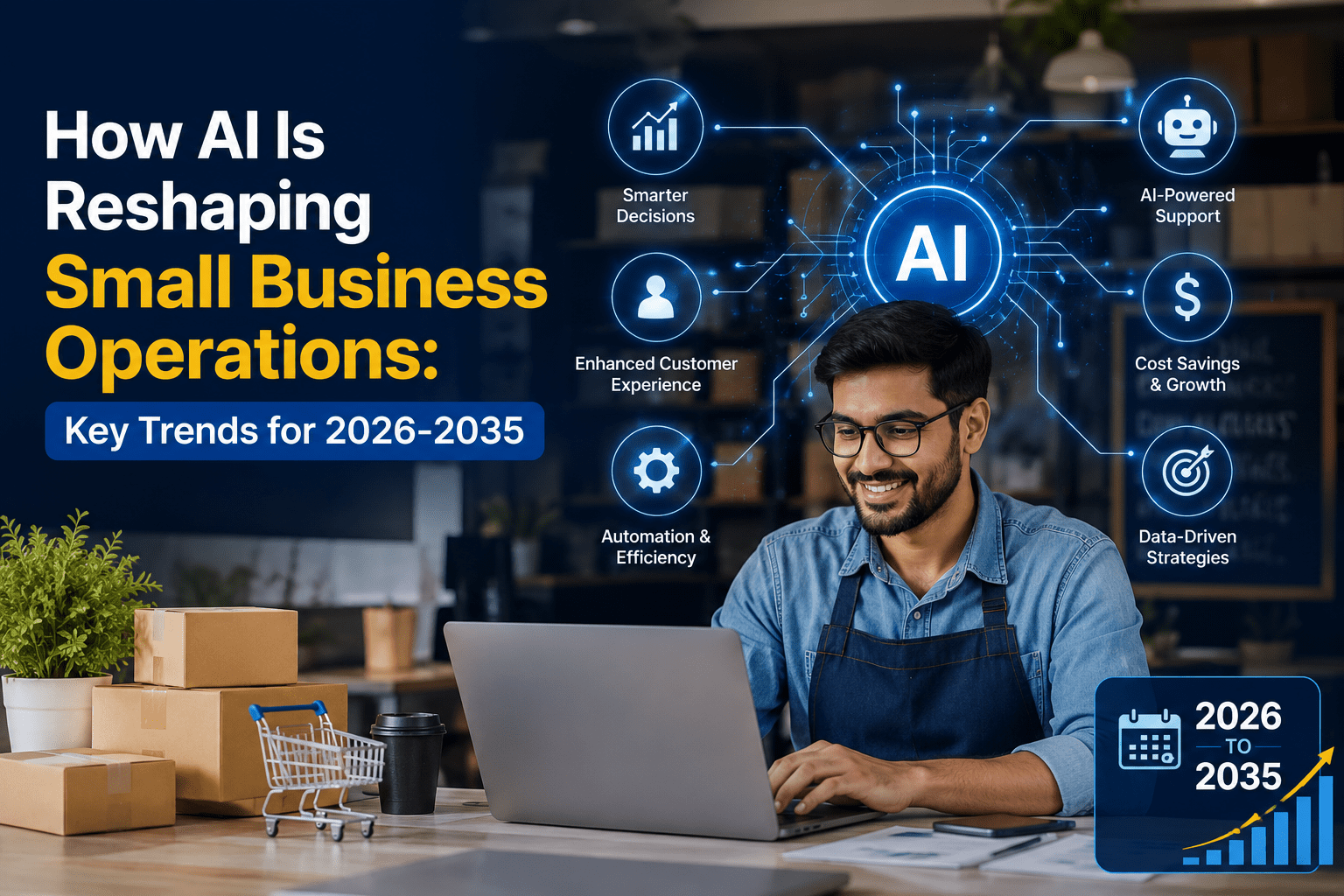
Artificial intelligence is rapidly moving from an emerging technology to a core business capability. While large enterprises were the earliest adopters, advances in cloud computing, software-as-a-service (SaaS), and generative AI have made sophisticated AI tools accessible to small and medium-sized businesses (SMBs). As AI adoption continues to grow, many professionals are enrolling in an Artificial Intelligence course to develop the skills needed to implement and manage AI-driven solutions in modern organizations.
Between 2026 and 2035, AI is expected to transform how small businesses operate, compete, and grow. From automating routine tasks to improving market intelligence and customer engagement, AI is reshaping the business landscape across industries. For business owners, understanding these trends will be essential for maintaining competitiveness in an increasingly data-driven economy.
The Democratization of AI for Small Businesses
Historically, AI adoption required significant investments in infrastructure, technical expertise, and data resources. Today, affordable AI-powered platforms have dramatically lowered these barriers.
Small businesses can now access AI capabilities through subscription-based tools that support customer service, marketing, accounting, inventory management, and business analytics. As a result, AI is no longer reserved for technology giants. Instead, it is becoming a practical operational tool for businesses of all sizes.
This democratization of AI is expected to accelerate throughout the next decade as software providers continue integrating AI features into everyday business applications.
AI-Driven Market Intelligence Is Changing Decision-Making
One of the most significant business impacts of AI is its ability to process and analyze large volumes of market data.
Traditional market research often relies on surveys, focus groups, and manual analysis. AI-powered platforms can now evaluate customer sentiment, monitor competitor activity, identify emerging trends, and analyze consumer behavior in real time.
For small businesses, this means faster and more informed decision-making. Business leaders can identify shifts in customer demand earlier, evaluate new market opportunities more effectively, and respond more quickly to competitive threats.
Companies that leverage AI-driven market intelligence may gain a substantial advantage over competitors that continue relying solely on traditional research methods.
Customer Experience Is Becoming a Competitive Differentiator
Customer expectations continue to evolve as digital experiences become more personalized.
AI enables small businesses to deliver tailored recommendations, personalized marketing campaigns, automated customer support, and customized shopping experiences. These capabilities help businesses improve customer satisfaction while increasing retention and conversion rates.
Industries such as retail, e-commerce, hospitality, and professional services are already seeing significant investments in AI-powered customer engagement technologies.
Over the next decade, personalization is likely to become a standard expectation rather than a competitive advantage, making AI adoption increasingly important for customer-facing businesses.
Industry-Specific AI Adoption Trends
The impact of AI will vary across sectors, but several industries are expected to experience particularly significant transformation.
Retail and E-Commerce
Retailers are using AI to forecast demand, optimize inventory, personalize recommendations, and automate customer support. These capabilities help businesses reduce operational costs while improving customer experiences.
Professional Services
Consulting firms, marketing agencies, accounting practices, and legal service providers are adopting AI to streamline administrative tasks, analyze data, and improve productivity. This allows professionals to focus on higher-value strategic work.
Manufacturing
Small manufacturers are increasingly deploying AI for predictive maintenance, quality control, and supply chain optimization. These applications help reduce downtime and improve operational efficiency.
Healthcare and Wellness
Healthcare providers and wellness businesses are utilizing AI for scheduling, patient communication, administrative automation, and operational planning. These tools support improved service delivery while reducing administrative burdens.
Logistics and Transportation
AI-driven route optimization, demand forecasting, and fleet management technologies are helping logistics businesses improve efficiency and lower operating costs.
The Rise of Predictive Business Operations
One of the most transformative developments expected between 2026 and 2035 is the shift from reactive to predictive business management.
AI systems can analyze historical and real-time data to forecast customer demand, predict inventory needs, identify operational risks, and estimate future revenue trends.
This predictive capability enables businesses to make proactive decisions rather than reacting after problems occur. As predictive analytics becomes more accessible, it is likely to become a standard component of business planning and strategy.
Workforce Evolution and Human-AI Collaboration
Concerns about job displacement continue to generate discussion, but many analysts believe the long-term trend will involve collaboration rather than replacement.
AI excels at repetitive, data-intensive, and administrative tasks. Human workers continue to provide creativity, strategic thinking, emotional intelligence, and relationship management.
As AI adoption expands, businesses will increasingly seek employees who can work effectively alongside AI tools. Skills such as data literacy, digital communication, problem-solving, and AI management are expected to become more valuable across industries.
Risks and Challenges Facing Small Businesses
Despite its potential benefits, AI adoption presents several challenges.
Data privacy concerns remain a major issue as businesses collect and process increasing amounts of customer information. Organizations must ensure compliance with evolving regulations and maintain strong cybersecurity practices.
Businesses handling sensitive customer information should also understand the growing cybersecurity risks associated with AI adoption and implement appropriate safeguards to protect their data and operations.
Additional challenges include implementation costs, employee training requirements, system integration complexities, and concerns about algorithmic bias.
Organizations that address these challenges proactively will be better positioned to maximize the value of AI investments.
What Business Leaders Should Expect by 2035
By 2035, AI is expected to be deeply integrated into everyday business operations. Small businesses that successfully adopt AI technologies will likely benefit from increased productivity, improved decision-making, enhanced customer experiences, and stronger competitive positioning.
Meanwhile, businesses that delay adoption may face growing pressure from more agile competitors that leverage AI to operate more efficiently and respond more quickly to market changes.
The next decade is unlikely to be defined by whether businesses use AI, but by how effectively they integrate it into their operations and strategic planning.
Conclusion
Artificial intelligence is reshaping small business operations across virtually every industry. From market research and customer engagement to predictive analytics and operational efficiency, AI is becoming a critical driver of business performance.
Between 2026 and 2035, organizations that embrace AI strategically will be better equipped to navigate changing market conditions, identify growth opportunities, and maintain competitiveness in an increasingly digital economy.
For business leaders, the opportunity is not simply to adopt AI, but to use it as a tool for smarter decision-making, stronger customer relationships, and sustainable long-term growth.
Author Bio
Cyber Safety Zone is a tech-focused platform that shares simple, easy-to-understand insights on cybersecurity and digital trends. It explores how online safety is evolving and helps readers stay aware of the risks and best practices in the digital world. You can learn more at cyber safety zone.